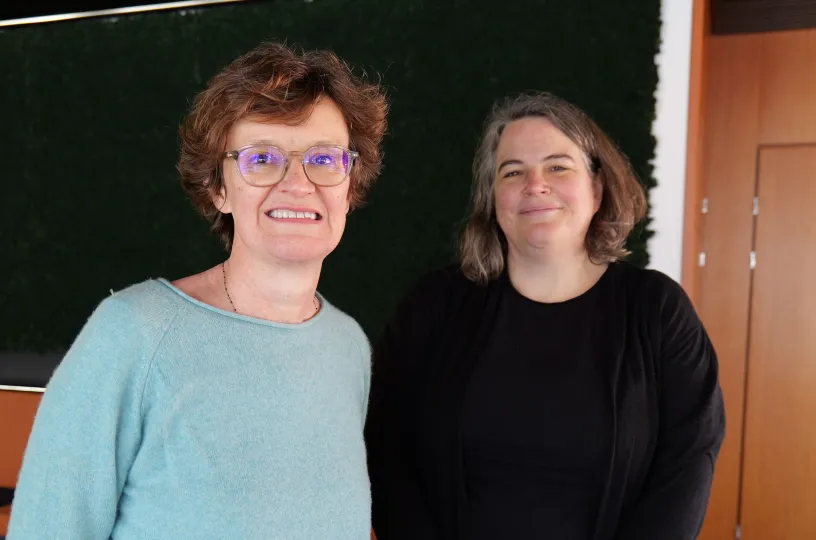
Together Judith and Isabelle make a complementary team, rooted in different experiences but united by the conviction that Europe’s industrial transformation must be shaped with workers rather than imposed on them.
Judith and Isabelle, how did you end up leading the European umbrella organization for industrial workers, IndustriALL?
Judith: I’ve spent my entire career working where workers’ rights, industrial policy and European democracy. As a member of the European Parliament, my motivation has always been the same: to build a fairer, more sustainable industrial future for workers. So, when I stepped into my current role of General Secretary in 2024, it felt like a very natural next step.
Isabelle: My path has been shaped by a lifelong commitment to trade unionism. I have spent many years inside industriAll Europe learning firsthand how powerful workers can be when they stand together across borders. Becoming Deputy General Secretary gave me the chance to turn that belief into concrete action at the European level.
The European social model is praised but not reflected in politics. What EU-level‑ regulation is needed?
Isabelle: The Draghi report rightfully states that competitiveness in Europe can’t be built by reducing wages. Yet, in practice, too many workers experience growing insecurity, pressure on wages and uneven levels of protection depending on where they live or work. If the EU is serious about renewing the social contract, it must turn warm words into binding commitments.
Firstly, we have to make sure that the current level of workers’ protection is not undermined. Europe suffers from too little investment in people and technology not too much regulation. We need an investment agenda that delivers on quality jobs. The proposed Quality Jobs Act is crucial to embed this investment into rights. It is about fair wages, good working conditions, health and safety at the workplace, training and robust collective bargaining and democracy at work.
In the current instability we find ourselves, Europe must build our internal resilience. As the Finns have long understood, common security is much more than defense spending alone. It is also about strategic autonomy underpinned by a pro-active industrial policy agenda and a renewed social contract with social dialogue and quality jobs at its core.
Europe is falling behind the U.S. and Asia in industrial development. What are the key measures to regain leadership?
Judith: Our industries — and the millions of workers behind them — face unprecedented structural pressures: unaffordable energy, supply chain fragilities, unfair global competition, and the enormous investment needs of the green and digital transitions. Our research shows that out of 20 key industrial sectors, only 2 – aerospace and shipbuilding (both linked to defense spending) remain in a relatively healthy shape. Investments are stalled and R&D is lagging behind. Meanwhile, once again windfall profits are being made by a few as a result of rocketing energy prices and geopolitical tension.
To regain industrial mojo, Europe needs a renewed sense of ambition. We need a major, pan-European investment effort that supports innovation, clean technologies and strategic industries. At the same time, Europe must put workers at the center of the transition, ensuring that skills development becomes a genuine priority rather than an afterthought.
There are many fears in Europe that AI will destroy jobs and, on the other hand, deprive employees of the possibility of privacy at work or even in their free time. The Commission has promised a right to disconnect, but what should be the next steps to protect workers’ rights and jobs in the technological transition?
Isabelle: AI in manufacturing is still in its infancy, but it is deployed at a neck-break speed. There is no evidence that it will destroy jobs, but it will definitively transform jobs and organizations. Workers’ concerns about AI are not about technology itself, but about being excluded from decisions that profoundly affect their working lives. Europe now needs a clear, worker approach to digitalization. AI should be introduced only with transparent dialogue and negotiation, ensuring that workers and their representatives help shape how these tools are deployed. This means reinforcing collective bargaining on digitalization and ensuring that AI cannot be used to undermine privacy or automate decisions that affect employment.
Would you have examples of the best national-level collective agreement provisions in Europe that have succeeded in protecting workers during the technological transition?
Judith: Across Europe, there are several strong models that show what works. In Germany, co‑determination gives workers formal influence over how new technologies are introduced, ensuring that digitalization supports both productivity and job quality. In 2022, the Swedish launched a comprehensive transition package aimed at strengthening long-term flexibility, career adaptability, and security in the labor market. And in Italy, sectoral agreements in manufacturing have established joint committees that track digitalization trends, assess risks and plan training needs collectively. These examples prove that when workers have real participation and strong institutions behind them, technological transitions become smoother, fairer and far more successful.
Trade policy has become a geopolitical weapon. Europe has chosen the path of open trade, and new free trade agreements have been finalized at a rapid pace. At the same time, the EU is trying to introduce laws that protect and restore industry. The contradiction is obvious, how should the EU navigate through this era of ‑power politics?
Judith: Europe must adapt to a world where trade is deeply intertwined with security, values and industrial strategy. The EU should remain open, but it cannot afford to be naïve. When partners distort markets, restrict exports or undermine labor rights, Europe needs tools to respond firmly and consistently. Trade agreements must contain enforceable labor rights, not just declarations. Europe must also reduce strategic vulnerabilities—particularly in energy, raw materials and key technologies—so that open trade does not translate into dangerous dependencies. Ultimately, trade policy should strengthen Europe’s industrial base and protect quality jobs. That's the only way Europe can navigate today’s era of geopolitical competition with confidence and solidarity.